
Pushkar blessings
Our brief encounter with a Brahmin priest, and some words of wisdom from grandma

Pushkar, India
Perhaps it’s temperament, or maybe karma, but I’ve never felt drawn to devotional religion, be it Christian or Hindu. But there I was at the foot of Jagatpita Shri Brahma Mandir, the world’s premier temple dedicated to the Vedic god of creation, so why not join the barefoot throng shoving its way up the stone steps and get a glimpse of the holiest of holies?
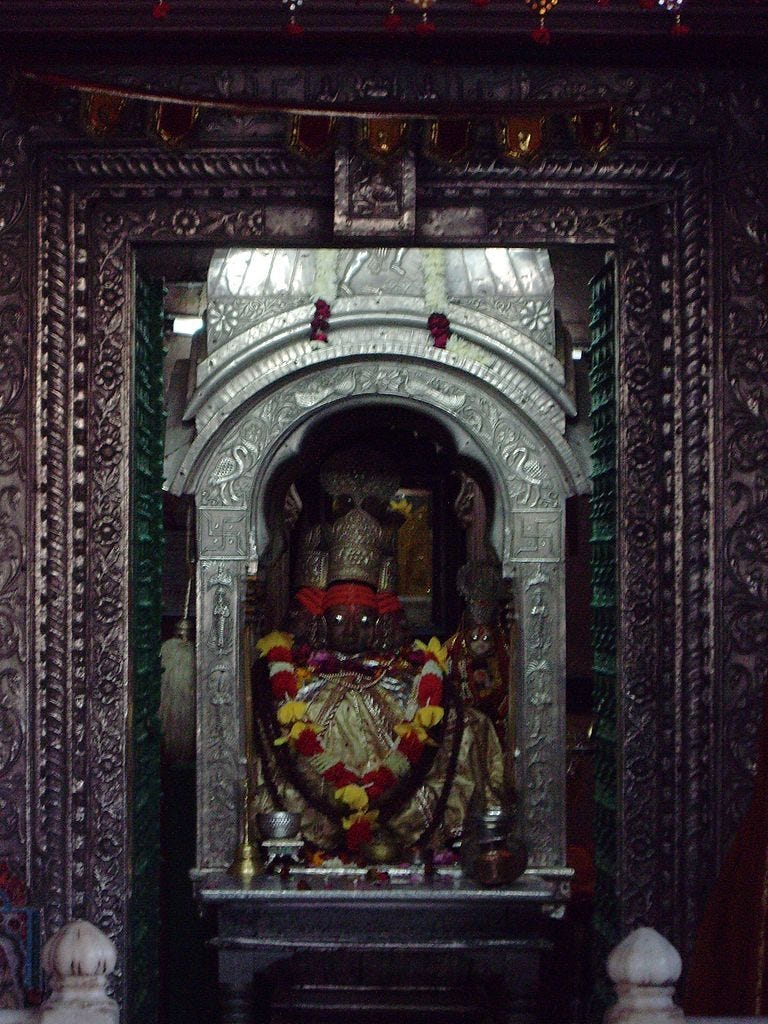
Men in white shirts and women in vibrant red, yellow and orange saris elbow their way up this ancient temple site on the banks of holy Lake Pushkar, carrying flowers and other offerings to place before a life-sized, four-faced marble idol of Lord Brahma. He is often depicted sitting cross-legged with his second consort, Gayatri. Legend has it that the god’s first wife, Savitri, cursed him for leaving her, and that’s why the only place he can be properly worshipped to this day was here in Pushkar.
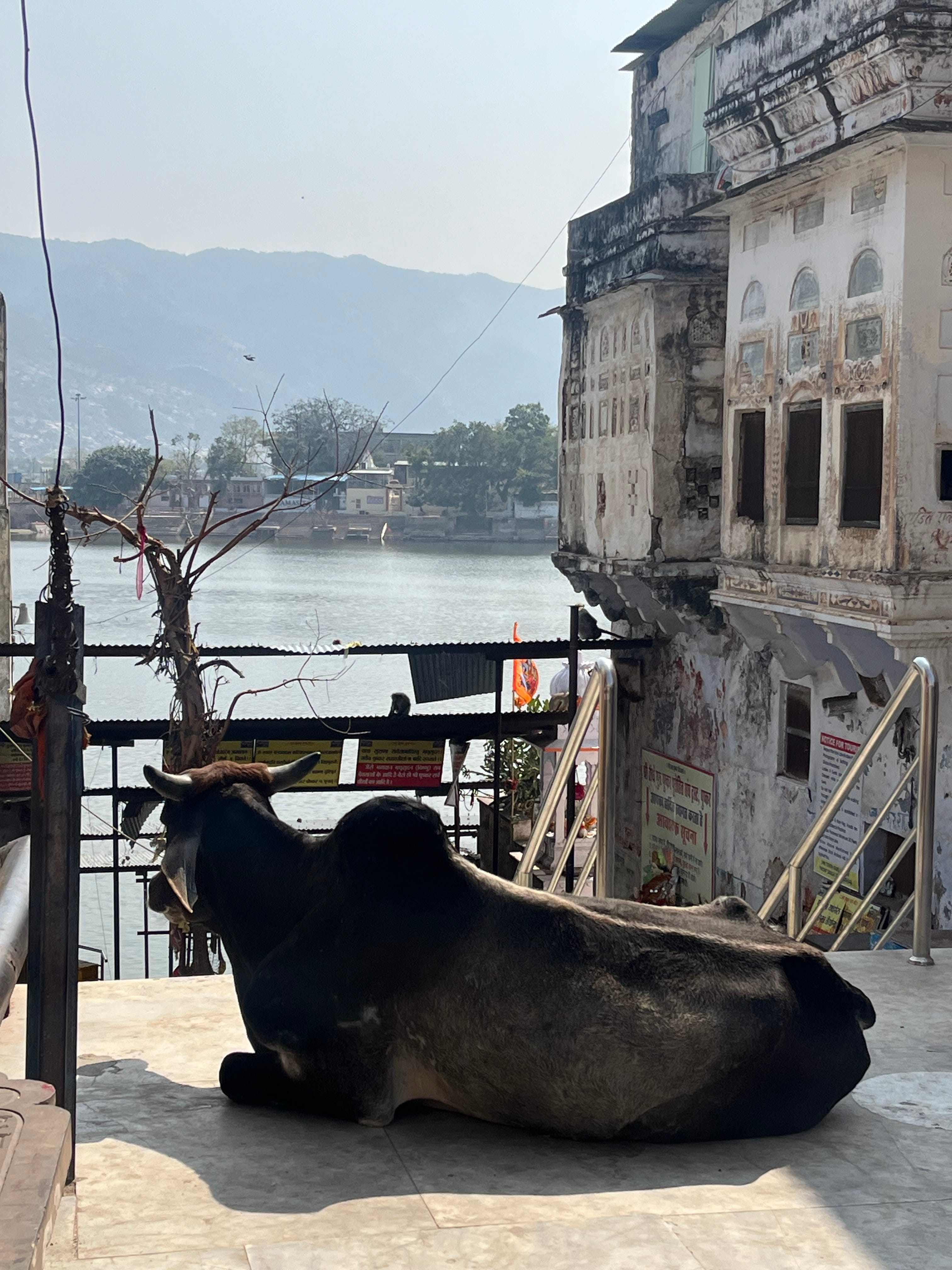
I’m here with my second consort, Laura, who has joined me on this squeeze through Hindu humanity. (My first wife cursed me for a while, but we’re friends now.) Laura and I are on a 14-day tour across Rajasthan with ten other travelers. We’re tourists, not pilgrims, but on this day some of us have chosen to walk the walk and maybe even talk the talk. Laura and I are the only Americans in our group, and we’re also the only ones who’ve decided to take off our shoes, climb the steps, and get a personal blessing from a Brahmin priest.
It’s so crowded at the top of the steps that we can barely see the idol, which is surrounded by a silver altar and mostly covered in white and orange garlands. We bring our palms together, bow our heads, and are soon pushed out of the way to make room for more devotees.
We file back down the steps and cross a courtyard filled with pilgrims coming and going. We then make our way toward one of 52 ghats that line the shoreline of this small lake, purportedly created by Lord Brahma when a lotus petal fell from the palm of his hand. Ghats are bathing shrines with steps leading down to the water for the performance of various rituals.
Our tour guide, Kuldeep, has arranged the meeting with our Brahmin priest, whose name is Vikas. Kuldeep is himself a member of the Brahmin caste, although he prefers the word “class,” arguing that the Western ideas about caste are a colonial misrepresentation of Hindu tradition.
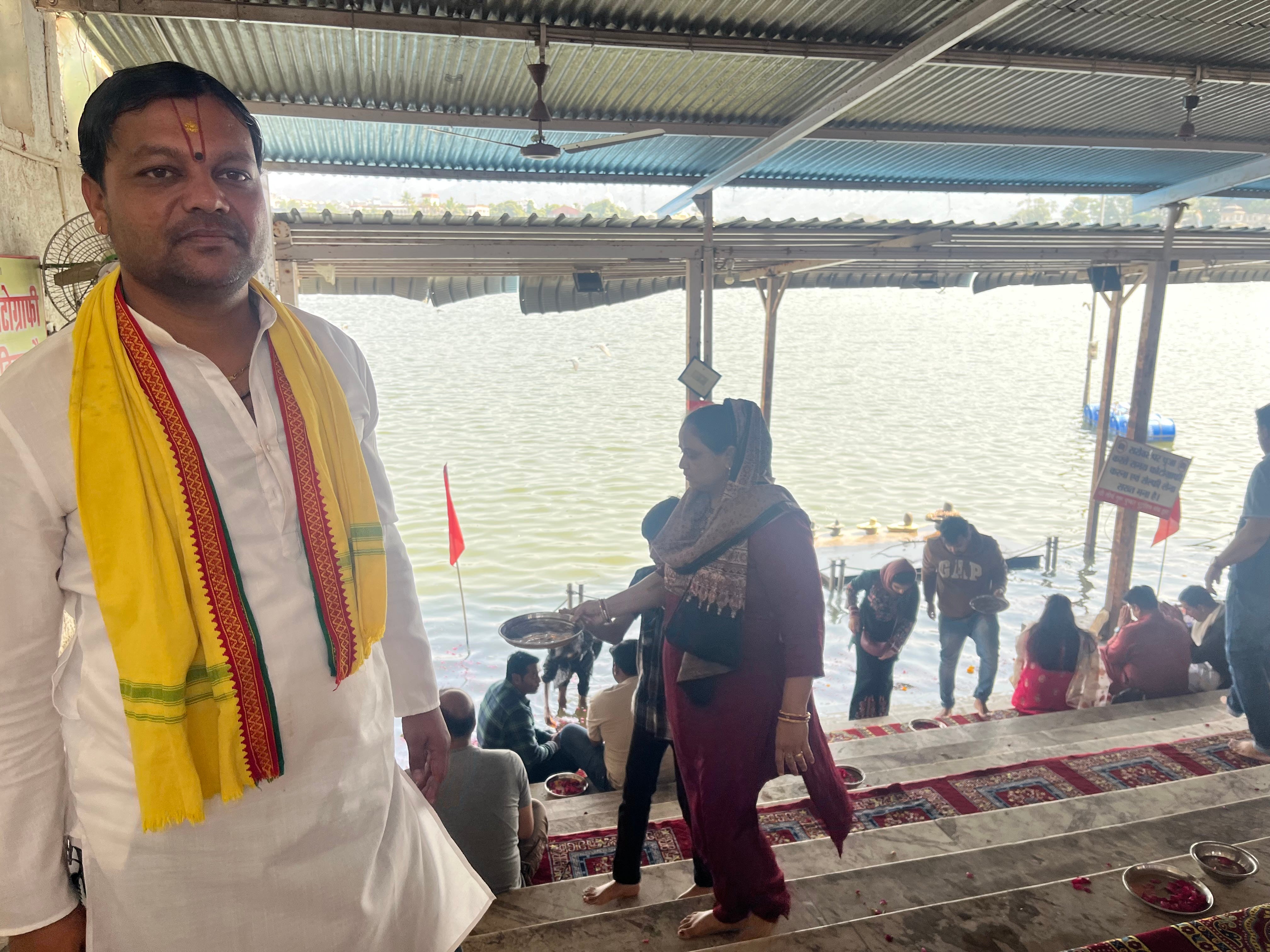
Vikas is dressed in white with a yellow and orange scarf draped around his neck, colors reflected in the elongated red “U” and gold dot painted on his forehead. In India, clothing and face paint speak volumes about the identity, marital status and caste/class of the wearer, including the ways in which Indian women wrap saris around their bodies. Vikas’ red “U” is a shout-out to Lord Vishnu. Many priests in Pushkar are Vaishnavite (devotees of Vishnu) even while serving near a Brahma temple.
Vikas directs us to sit on a long strip of carpeting that cushions every fourth step leading to the water. He hands us a round silver tray with flower blossoms, a yellow paste and tiny piles of sugar and salt. There’s another silver bowl with holy water brought up from the lake.
He asks a series of questions. Are we married? Do we have children? What are their names? Do we have living brothers, sisters, parents or grandparents? What are their names?
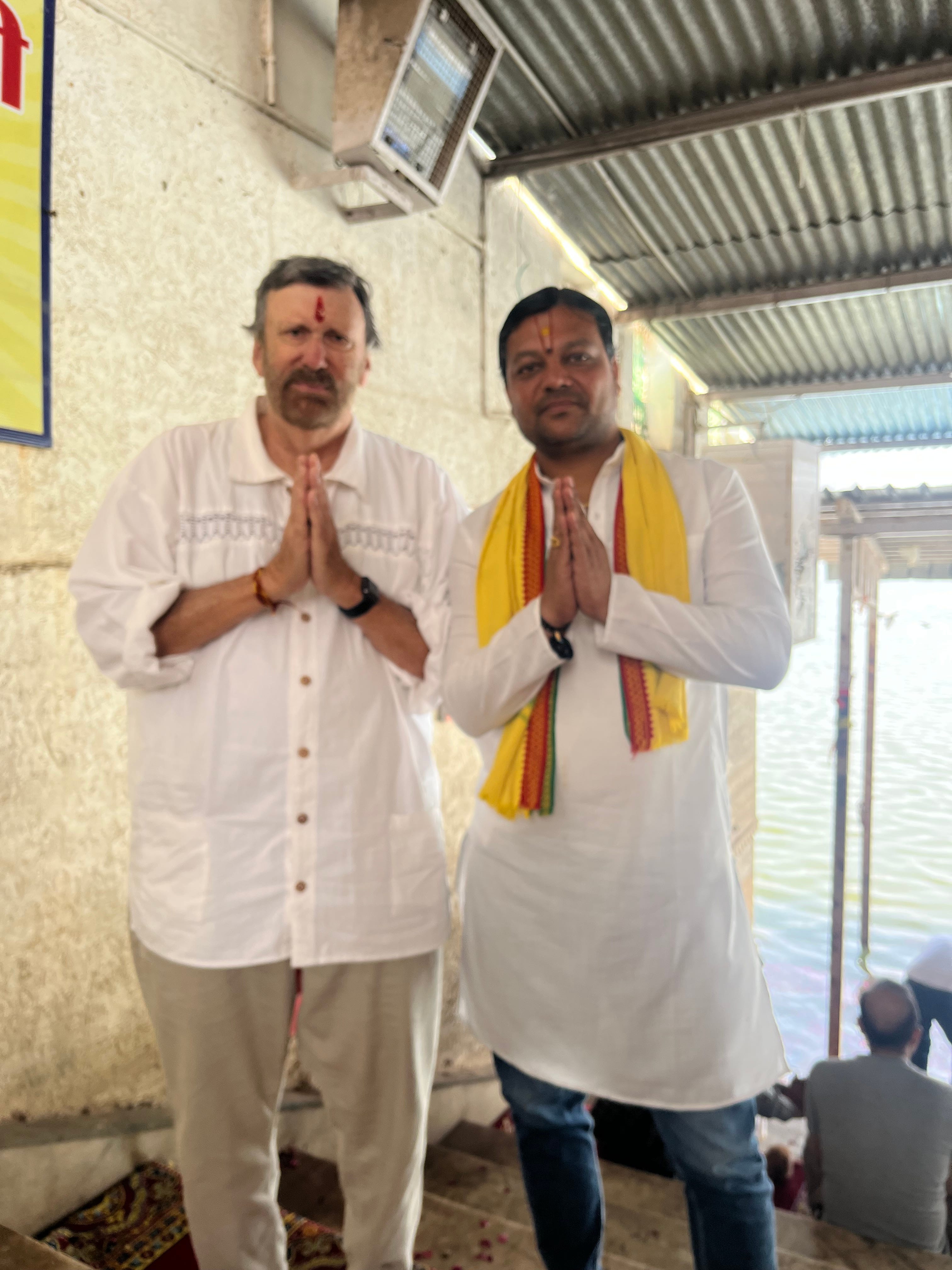
After marking Laura’s forehead with a red dot and mine with a vertical red line, the priest instructs us to bring our palms together, holding a red flower between them. He dribbles some lake water over our joined hands, then recites a series of verbal blessings for us repeat.
We chant after him “Brahma pray. Vishnu pray. Shiva pray.” And then go on to pray for own family members, ancestors, town and country.
“It felt very rich for me to do it,” Laura said later. “It reminded me of how, I, as a child, would pray to God to take care of everyone in my family and my friends. I felt enriched and relieved, partly because it was a chance for us to finally get away from the group.”
Ah, yes. The group. We’re new to group travel, but the chaos of India, combined with our aging brains and bodies, inspired us to sign onto a small group tour with Intrepid, an Australian tour company. It turned out to be a convenient way for first-time visitors to see a little slice of this wondrous land, but we did grow tired of the forced march of group travel and the difficulty to linger and reflect before moving on to the next attraction. If it’s Tuesday, this must be the Taj Mahal.
India is a huge country, and our two-week group tour just focused on a slice of it, mostly in the north-central state of Rajasthan. We had a final, third week of solo travel, allowing us to visit the bustling pilgrimage town of Varanasi and the incredible Ajanta/Ellora caves. More on that next week.
Our guide for the 12-person group tour, Kuldeep, comes from Udaipur, famous for its City Palace, which rises from the shores of shimmering Lake Pichola. It was founded in the late sixteenth century as the seat of the Mewar dynasty.
During long bus rides across Rajasthan, Kuldeep had plenty of time to share stories about his country, his family and his spiritual life. A tale that stuck with me was one of several he told about his grandmother, a wise woman who never went to school. One day she was with her grandchildren watching a television program based on the Mahabharata, one of the two major Sanskrit epics of ancient India. At the end of the show, she asked the kids what they thought was the purpose of life.
Big question for little kids, or for a bunch of tourists on a bus roaring across Rajasthan. What is the purpose of life?
Enlightenment?
Helping others?
Finding your true self or your true path?
Fine answers, replied Grandma/Kuldeep. But what do we really want in life?
Silence, prompting him/her to offer one possible answer.
Happiness. We all want happiness.
Sounds simple, but how do we find happiness? Grandma and Kuldeep suggested that we just try to live by keeping two things in mind.
No expectations.
No complaints.
Good advice — for life and for a fast-paced tour of India.
If only Laura had changed her name to Tina before the pilgrimage, she would have been your Consort-Tina. Would Lord Brahma have appreciated that? 🙏